Oct 6, 2026Quality & Materials
FDA, LFGB, ROHS, REACH: What Kitchen-Tool Certifications Mean for Buyers
What FDA, LFGB, ROHS and REACH actually tell a buyer, why each one shows up in RFQs, and how to request certificates tied to your exact model instead of a supplier's catalog.
Ask any experienced buyer what starts an outdoor-cooking RFQ, and the answer is rarely price. It is paperwork. Long before tooling costs or lead times enter the conversation, a purchasing team wants to know which marks a product carries, which markets it can legally ship to, and what documentation will arrive with the shipment. Four abbreviations dominate those conversations: FDA, LFGB, ROHS and REACH. This article explains what each one signals from a purchasing perspective, why your retail customers keep asking for them, and how to request certificates that actually protect your business.
Why Certification Questions Belong in Your RFQ
Certifications are not marketing badges, and they are not a proxy for how good a factory is. They answer three questions a buyer cannot answer any other way: which markets this product can enter, which parts of it have been assessed for food contact or chemical compliance, and who holds the proof when a retailer, marketplace or customs officer asks for it.
Retail groups usually request certificates before they will list a SKU. Marketplace platforms increasingly require them during seller onboarding. Importers into the EU and the US are the ones who must produce documents on demand. If the paperwork is missing, generic or mismatched to the product, those questions come straight back to you. Experienced buyers therefore treat certification as part of the product definition — specified per model in the RFQ, not assumed from a supplier's catalog.
FDA: The Baseline for the US Market
When a buyer asks whether a kitchen tool is "FDA", they are asking whether its food-contact materials have been assessed against the United States framework for materials that touch food. For kitchen tools, tableware and cutlery headed to American shelves, it is the entry ticket: US retail chains expect it named in the compliance file, and many will not move forward without it.
From a purchasing standpoint, read FDA as a market-access statement. It says the food-contact surfaces of this product were reviewed for the US market's rules on materials that meet food. It is not a quality grade and not a durability rating. If a supplier quotes FDA on one flagship product, do not assume it extends across the range — treat it as a per-model fact to confirm.
LFGB: The Benchmark EU Buyers Ask About
LFGB refers to the German food-contact framework, and among buyers it has a reputation as the more demanding benchmark for kitchenware sold in Europe. Even in markets where another mark would satisfy the minimum, many European retail groups ask for LFGB first, because it simplifies their internal review: a product assessed under the German framework tends to pass their compliance checks with fewer follow-up questions.
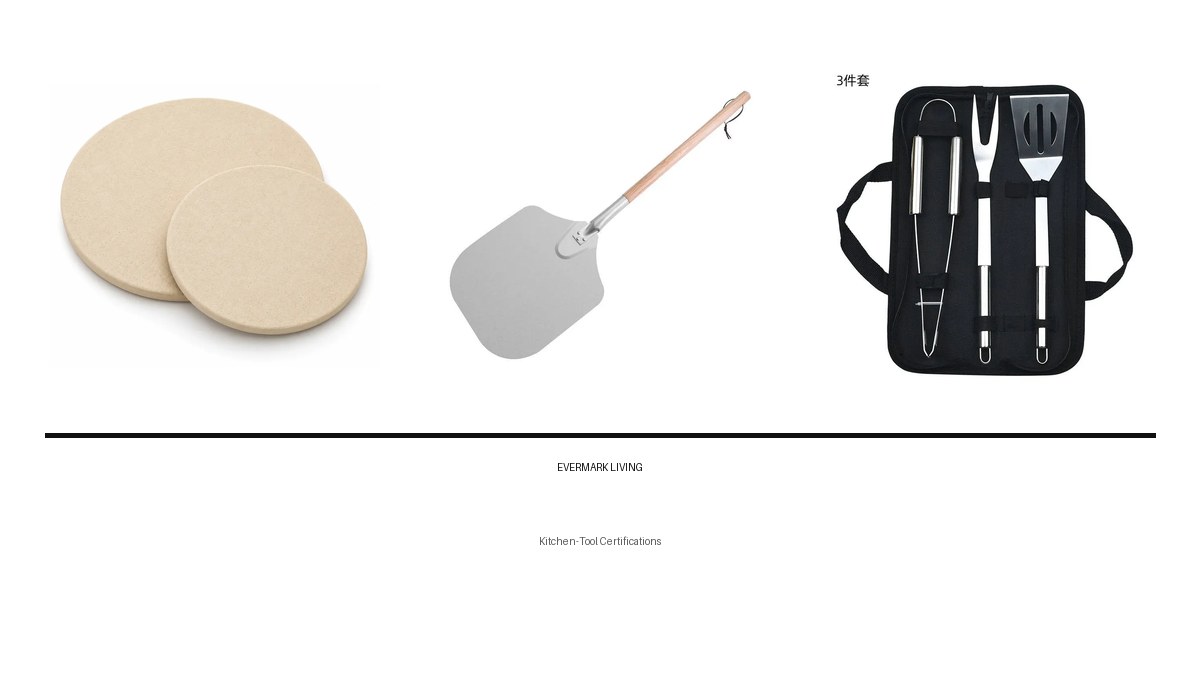
For you, LFGB on a certificate does two things. It signals the supplier has invested in EU-facing compliance rather than the cheapest possible file. And it gives your retail customers a document their quality teams already know how to read. On items such as pizza stones — where the whole product is food-contact and material choice matters — it is often the first abbreviation written into the spec sheet.
ROHS and REACH: The Marks for the Parts That Never Touch Food
Not every component of an outdoor-cooking tool meets food. Handles, grip inserts, nylon serving heads, hardware and packaging all travel with the product, and ROHS and REACH exist to answer a simple buyer question: what is in the rest of it?
REACH is the European Union's chemical regulation, and its reach is broad: it applies across materials and components, so EU-bound buyers treat it as a whole-product statement rather than a single-part one. ROHS originated around electrical products, but purchasing teams borrowed the habit: where a product contains substantial non-food components such as nylon or coated hardware, asking for ROHS alongside REACH has become a common shorthand for "the non-food-contact parts have been assessed too."
From your side, these two marks matter most on mixed-material products — a stainless head with a nylon handle, for example — where the food-contact story and the component story need separate proof.
How to Ask for Certificates the Right Way
This is where sourcing conversations are won or lost. The single most useful sentence you can send a supplier is this: ask for certificates bound to the specific model, not catalog-level generic certificates. A catalog-level file may name a product family, a discontinued SKU or nothing identifiable at all — which means it proves nothing when your customer's compliance team reviews it.
A usable request looks like this:
Name the exact model number and product name in writing, and require them to appear on the certificate itself.
Ask which parts of the product the document covers — the food-contact surfaces, the non-food components, or the complete unit.
For mixed-material models, ask which mark covers which component, so nothing falls between documents.
Confirm the issue date and renewal cycle, and request updated versions when the product or its materials change.
Ask for the certificates as PDFs before you confirm the order, and file them against the SKU so they travel with every reorder.
Suppliers used to export business answer these requests routinely. Hesitation or vague replies are themselves useful purchasing information.
Talk to Evermark Living
Certification paperwork should never be the reason a shipment stalls. Evermark Living supplies FDA and LFGB documentation per model across its cutlery and tableware lines, LFGB documentation for its pizza stone, and ROHS plus REACH documentation for the nylon components used across its outdoor-cooking tools — held per model, so what you file matches what you ship.
Next step: send us your target product list and destination market, and we will return a per-model certificate pack you can hand directly to your retail or compliance team. Start the conversation through our contact page, or request a quote with your SKU list attached.