Jul 31, 2026Buying Guides
How to Choose the Right Stove Fan Supplier: 7 Things Fireplace Distributors Should Check Before Ordering
Choosing a stove fan supplier? Here are seven checks that help fireplace distributors reduce quality, inventory and after-sales risks before ordering.
Choosing a stove fan supplier should involve more than comparing unit prices and blade counts. Fireplace distributors need to check whether the supplier understands end-user complaints, provides suitable models, controls batch quality and supports packaging, samples and after-sales needs. These factors directly affect returns, reviews and repeat orders.
Heat powered stove fans may look like simple fireplace accessories, but small differences in performance, compatibility and packaging can create very different customer experiences.
End users commonly complain that a fan:
- spins but moves little noticeable air;
- does not start on their stove;
- becomes noisy after several weeks;
- looks smaller than expected;
- arrives with bent blades;
- stops working during the heating season.
For a distributor, these problems mean more than one unhappy customer. They can lead to refunds, replacement costs, lower online ratings and loss of trust with retail accounts.
Before placing an order, fireplace distributors should therefore evaluate the supplier as carefully as the product.
1. Does the Supplier Understand the End-User Market?
A supplier should understand why consumers buy stove fans and what makes them return them.
Most end users are not comparing aluminium grades or motor specifications. They want:
- more balanced warmth in the room;
- quiet operation;
- simple installation;
- no power cable;
- reliable seasonal use;
- a product that fits their stove.
A useful supplier should ask about:
- your target country;
- common stove types;
- typical room and application;
- online or offline sales channels;
- target retail price;
- common customer complaints.
A supplier who recommends the same model for every market may not be considering compatibility or return risk.
For example, a compact UK log burner, a Canadian cabin stove and a hot-tent stove may require different dimensions, installation methods and product positioning.
2. Are Performance Claims Supported by Clear Test Conditions?
Many stove fan listings use terms such as:
- high airflow;
- low start-up temperature;
- ultra-quiet;
- improved heating efficiency.
These claims are difficult to compare without test conditions.
A B2B buyer should ask:
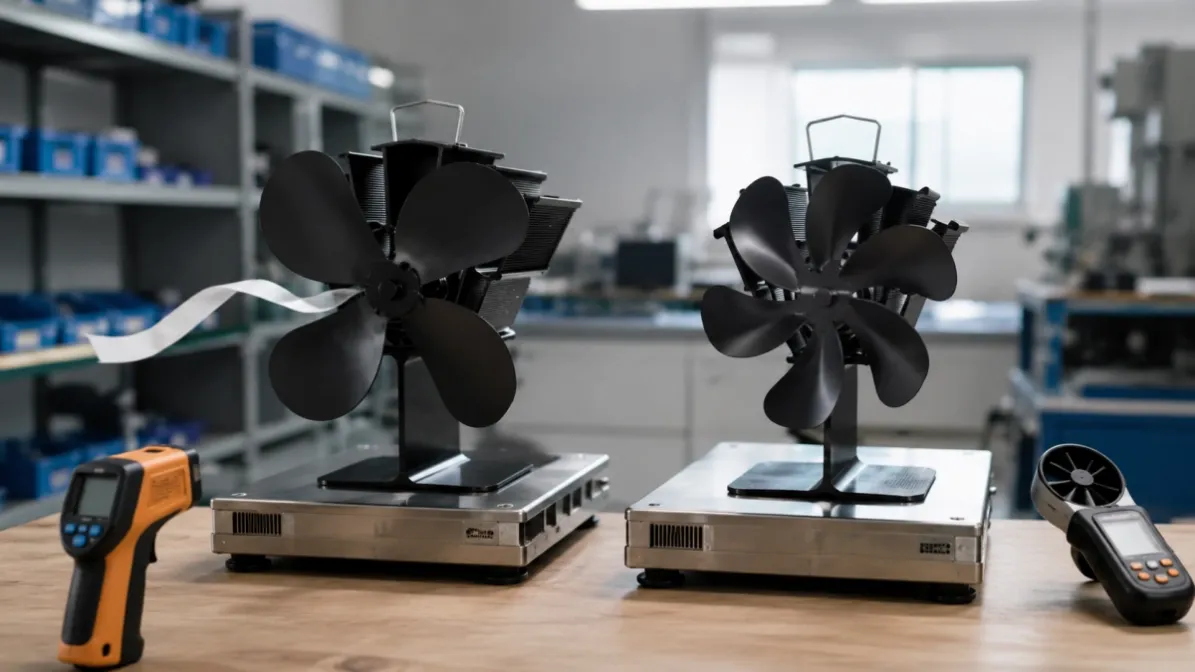
- At what surface temperature do the blades begin rotating?
- At what temperature does the fan produce useful airflow?
- At which temperatures were RPM or airflow measured?
- At what distance was airflow tested?
- How was noise measured?
- What was the ambient temperature?
Starting to rotate is not the same as producing effective airflow.
A supplier should be able to explain how its performance figures were produced, instead of providing only one maximum value.
3. Is Batch Quality Controlled, Not Just the Sample?
A good sample does not guarantee consistent mass production.
Distributors should ask how the supplier controls:
- thermoelectric modules;
- motors;
- blade balance;
- shaft movement;
- heat-sink assembly;
- wiring and connections;
- overheat-protection components;
- finished-product appearance.
It is also useful to ask whether the supplier performs:
- start-up checks;
- noise checks;
- continuous-operation tests;
- repeated heating and cooling tests;
- pre-shipment inspections.
The aim is not to demand complicated laboratory reports for every low-cost model. The aim is to understand whether the supplier has a repeatable method for identifying defects before shipment.
4. Does the Product Range Match Different Stove Applications?
A large catalogue is not automatically better.
What matters is whether the product range covers meaningful end-user situations.
End-user application | Suitable product direction |
|---|---|
Flat stove top with enough space | Standard stove-top fan |
Small log burner | Compact stove-top model |
No suitable flat top surface | Clamp-mounted or pipe-mounted fan |
Compatible steel or cast-iron surface | Magnetic model |
Indoor and outdoor use | Dual-use mounting structure |
Lower surface-temperature stove | Model tested for lower-temperature operation |
A distributor may only need four clearly positioned models rather than twenty similar-looking SKUs:
- one mainstream stove-top fan;
- one compact model;
- one clamp-mounted or magnetic model;
- one premium or durability-focused option.
This makes the range easier for sales teams and end users to understand while reducing unnecessary inventory.
5. Can the Supplier Support OEM and Private-Label Requirements?
Private label should involve more than printing a logo on an existing box.
Depending on the market and order quantity, buyers may need:
- logo placement;
- blade or product colour options;
- retail-ready colour boxes;
- kraft packaging;
- multilingual manuals;
- barcode and label placement;
- QR-code installation guides;
- thermometer or accessory sets;
- market-specific FAQs.
Before ordering, confirm:
- which parts can be customized;
- minimum quantities for each customization;
- sample or artwork approval process;
- colour-matching method;
- packaging lead time;
- responsibility for checking final artwork.
Clear approval steps help prevent incorrect logos, colours, labels and manuals during production.
6. Are MOQ, Samples and Packaging Suitable for Your Sales Plan?
A low unit price is not valuable if the required order quantity creates excessive stock.
This is especially important for seasonal fireplace products.
A practical supplier should help buyers evaluate:
- sample quantity;
- mixed-model trial orders;
- standard versus customized MOQ;
- carton quantities;
- seasonal replenishment;
- packaging options for retail or e-commerce.
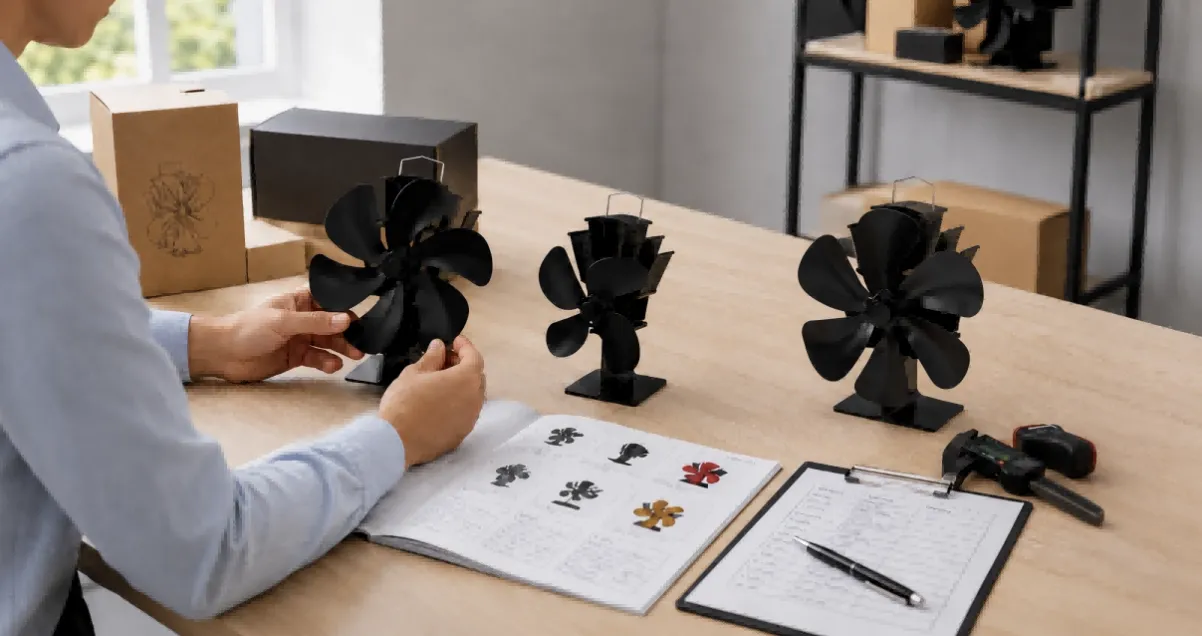
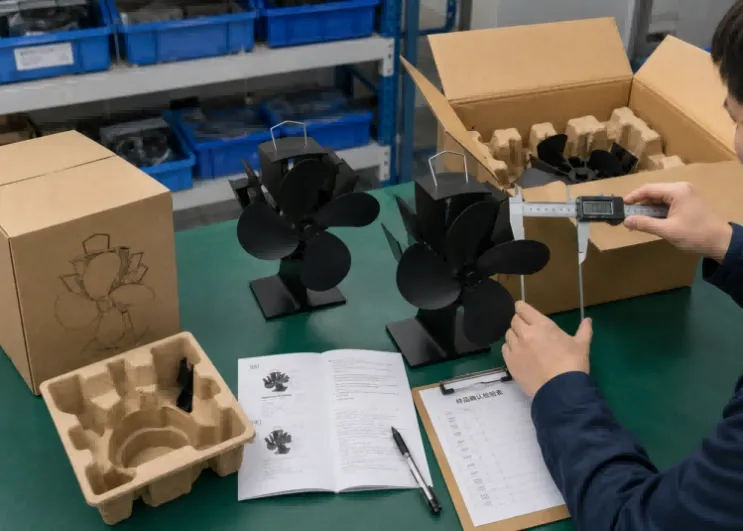
Samples should be tested on more than appearance.
A basic sample check should include:
- start-up behaviour;
- airflow at more than one temperature;
- noise and vibration;
- blade alignment;
- product dimensions;
- packaging protection;
- installation instructions.
Packaging should hold the fan securely and keep pressure away from the blade edges. A product that leaves the factory in good condition can still create complaints if the blades are bent during international shipping.
7. How Does the Supplier Handle Communication and After-Sales Issues?
Communication becomes especially important before and during the heating season.
A suitable supplier should provide clear answers about:
- quotation validity;
- sample preparation;
- customization details;
- production progress;
- inspection;
- shipment;
- replacement parts;
- quality claims.
Before ordering, ask how the supplier handles situations such as:
- a blade damaged during transport;
- an abnormal motor;
- incorrect packaging artwork;
- missing instructions;
- a batch-related complaint;
- urgent seasonal replenishment.
A reliable supplier should not promise that problems will never happen. It should provide a clear process for identifying causes and agreeing on a practical solution.
A Quick Supplier Evaluation Checklist
Area | What distributors should confirm |
|---|---|
Market knowledge | Target market, stove type and end-user needs |
Performance | Start-up, airflow and noise test conditions |
Quality | Motor, TEG, blade balance and batch inspection |
Product range | Stove-top, compact, clamp, magnetic or dual-use options |
OEM | Logo, colour, packaging, manual and label support |
Order flexibility | Samples, MOQ, mixed models and seasonal planning |
After-sales | Response process, spare parts and claim handling |
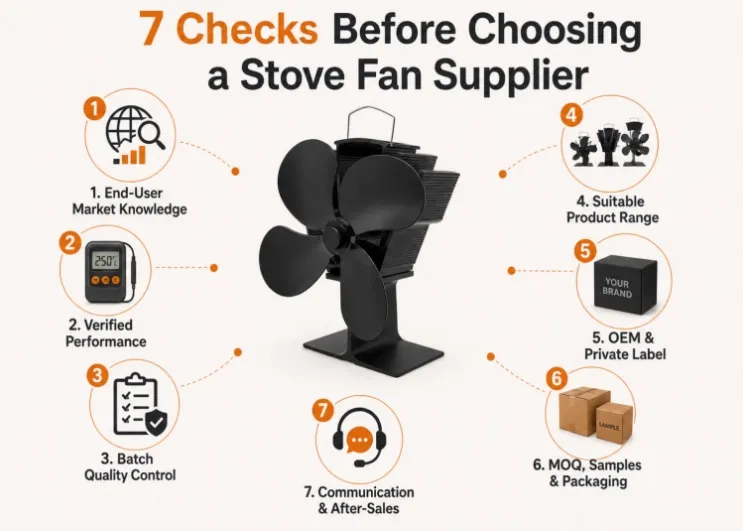
A supplier that performs well across all seven areas is more likely to support stable long-term sales than one competing only on price.
Frequently Asked Questions
What is the most important factor when choosing a stove fan supplier?
There is no single factor. Market compatibility, consistent quality, clear performance information, packaging and communication all affect the final customer experience.
Should distributors choose the supplier with the lowest price?
Not necessarily. A lower purchase price may be offset by higher returns, replacements, poor reviews and customer-service costs.
How many stove fan models should a distributor start with?
A focused range of three or four clearly positioned models is often easier to manage than many nearly identical SKUs.
Should buyers test samples before placing a bulk order?
Yes. Samples should be checked for start-up, airflow, noise, vibration, dimensions, installation and packaging protection.
What can normally be customized for private-label stove fans?
Options may include logos, colours, boxes, manuals, labels, barcodes and accessory sets, depending on the product and order quantity.
Choosing a Stove Fan Supplier for Your Market?
Evermark Living supports fireplace retailers, distributors, e-commerce sellers and private-label buyers with stove-top, compact, clamp-mounted, magnetic and dual-use stove fan options.
Send us:
- your target market;
- main customer type;
- common stove applications;
- preferred product positioning;
- expected order quantity;
- packaging or private-label requirements.
We can recommend a practical product combination and discuss samples, packaging and B2B pricing.
Request our stove fan catalogue or a sample recommendation for your market.